For developers8 min
The twenty-year economics of a resort thatch roof
Developers compare roof systems on cost per square metre at tender. Owners live with a different number: what the roof costs to keep, and what it costs the property every time it has to be closed. This note works through the second one.
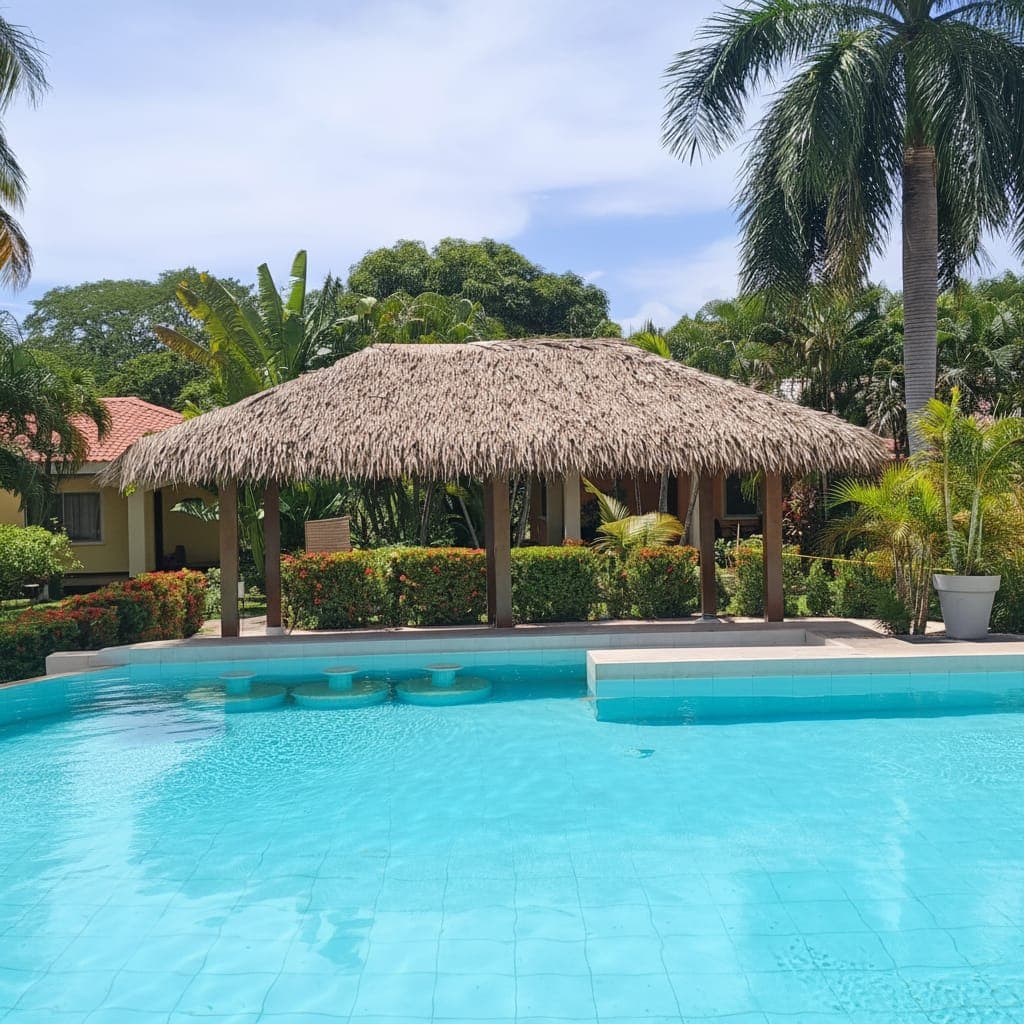
A beach club, a pool bar and a lobby palapa are revenue-generating floor area with a roof over it. That framing changes the analysis, because a roof that periodically takes the area out of service is not just a maintenance cost — it is a revenue cost, and it lands in high season as often as not.
The three costs of a natural fibre roof
Natural palm thatch carries a re-thatching cycle of roughly three to five years in Costa Rican coastal conditions. Each cycle carries three separate costs, and construction budgets usually capture only the first.
- The re-thatching itself: material, crew, scaffolding, waste removal.
- The closure: an area out of service for the duration, plus the guest experience of scaffolding across a pool deck.
- The interim maintenance: treatment against insects and fungi, patch repairs after storms, and cleaning fibre out of the pool and the filtration system.
What the synthetic side of the model looks like
A NIPA® synthetic thatch roof is specified against test data rather than against a maintenance cycle:
| Line | Synthetic thatch | Natural fibre |
|---|---|---|
| Replacement cycle | 20-year documented warranty | Re-thatch every 3–5 years |
| Area closures for maintenance | None scheduled | One per cycle, plus repairs |
| Pool and filtration | No organic shedding | Fibre in the water, filter load |
| Pest management | No organic matter to host | Insects, rodents, fungi |
| Insurable fire performance | Class A (ASTM E108) | Cannot be classified |
Where the numbers come from
Three figures do most of the work in an underwriting conversation, and all three are third-party test results rather than manufacturer claims: Class A under ASTM E108 for the roof covering, wind certification at 260 km/h, and 6,000 hours of accelerated UV exposure under ASTM G155 — roughly twelve years of intense tropical sun.
For a coastal property in Guanacaste or the Papagayo peninsula, the wind figure is usually the one the insurer reaches for first and the one a vegetal roof cannot answer.
Phasing, which is where programmes actually slip
Material is held in regional stock and delivered palletised by phase — 11 m² per box, 370 m² per pallet — so a phased resort build does not wait on an import container for each block, and does not tie up storage for a year of construction either.
Installation goes over battens with no sub-roof or membrane, which keeps the roof inside a single programme activity rather than spread across three trades.
What to ask for at feasibility stage
- Sloped-area take-off on the schematic roof plan, not a projected-plan estimate.
- Test documentation with the scope of each test stated, for the insurer and the fire review.
- A phasing plan matched to your construction programme and regional stock.
- The warranty letter, with exactly what it covers and who issues it.
All four are issued by palm.cr, the authorized NIPA® distributor in Costa Rica, and are typically returned the same business day.